Stable water is the single biggest factor in a healthy aquarium. Fish and corals don't just react to bad water, they react to changing water. The keepers with the best-looking tanks aren't chasing miracle additives; they're testing regularly, doing consistent water changes, and starting with clean source water. This guide covers what to track in both saltwater and freshwater systems, and how to keep those numbers steady.
Start with your source water
Tap water is rarely a blank slate. Depending on your municipality it can carry chlorine or chloramine, heavy metals like copper, and most problematic for aquariums; nitrates, phosphates, and silicates. Those last three are fuel for nuisance algae and a common source of mystery problems that no amount of dosing will fix.
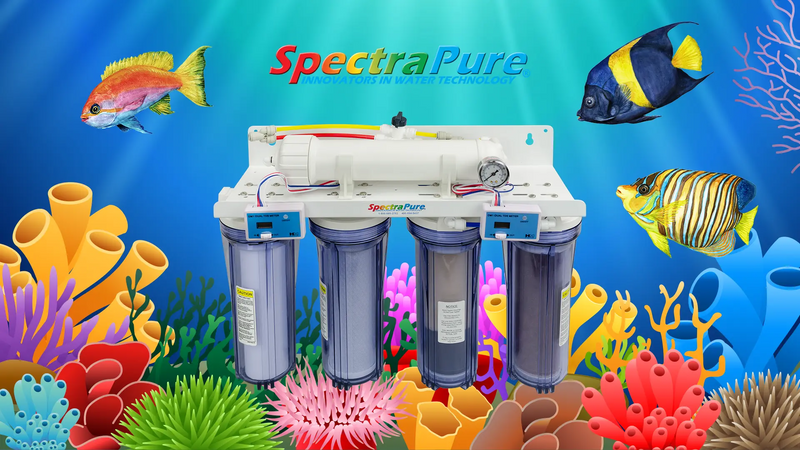
The fix is to start with water that has nothing in it. A reverse osmosis / deionization (RO/DI) system strips source water down to 0 TDS (total dissolved solids), giving you a known, repeatable baseline to build on. SpectraPure RO/DI systems have been hand-built in Tempe, Arizona since 1985, and we manufacture our own DI resin in house, so you can see a true 0 TDS reading before that water ever touches your tank.
Maintaining a saltwater (reef & marine) aquarium
Reef tanks are less forgiving than freshwater because corals depend on a tight band of chemistry. Target and hold these ranges:
- Salinity: 1.025–1.026 specific gravity (~35 ppt)
- Temperature: 76–82°F, held stable
- pH: 8.1–8.4
- Alkalinity: 8–12 dKH
- Calcium: 380–450 ppm
- Magnesium: 1250–1350 ppm
- Ammonia & nitrite: 0 ppm
- Nitrate: below ~5–10 ppm for most reefs
- Phosphate: roughly 0.03–0.10 ppm
Alkalinity, calcium, and magnesium move together and drive coral skeletal growth—test these weekly and dose to hold them steady rather than letting them swing. Just as important is what you keep out. Silicates feed diatom blooms (the brown dusting on new tanks), and phosphates feed hair algae and cyanobacteria. Both ride in on poor source water.
This is exactly why we make a DI resin cartridge specifically for reef keepers. Standard mixed-bed resin can let silica slip through as it nears exhaustion. Our SilicaBuster DI cartridge is formulated to capture silica that ordinary resin misses, which is what keeps diatoms from reappearing in an otherwise clean reef. Pairing it with our color-indicating mixed-bed DI lets you see at a glance when resin is spent, so your RO/DI never quietly drifts above 0 TDS. Always confirm a 0 TDS reading before mixing your salt, and mix new saltwater from RO/DI for every water change. Browse our RO/DI resin cartridges to match resin to your tank.
Maintaining a freshwater aquarium
Freshwater tanks give you more margin, but the fundamentals still rule. Everything starts with the nitrogen cycle: establish beneficial bacteria before adding livestock, then hold these targets:
- Ammonia & nitrite: 0 ppm at all times
- Nitrate: below 20–40 ppm (lower for sensitive species)
- pH: matched to your species and kept stable
- General hardness (GH) & carbonate hardness (KH): appropriate to the fish you keep
- Temperature: species-appropriate and consistent
If your tap water is heavily chlorinated, treat or pre-filter it before it goes in. For sensitive or specialty setups. For discus, dwarf shrimp, soft-water species, and planted “aquascapes” many hobbyists start with RO/DI water and remineralize it back up to a precise GH/KH. That approach gives you complete control over hardness and TDS instead of inheriting whatever your utility delivers that week. A SpectraPure RO/DI system plus a remineralization cartridge makes that repeatable.
A simple maintenance routine
- Weekly: test your core parameters and perform a 10–25% water change with fresh RO/DI (remineralized for freshwater, salt-mixed for reef).
- Check your RO/DI: take a TDS reading of your product water, either manually or with your on-system TDS meter, it should read 0. If it creeps up, your DI resin is exhausting.
- Replace media on schedule: sediment and carbon pre-filters every 3-6 months, the RO membrane every 1-2 years (both depending on your incoming water quality), and DI resin whenever it's spent (color-indicating resin makes this obvious, but co2 and other factors can affect coloration quicker than the resin's capacity)
- Keep records: a simple log of test results makes trends and problems visible early.
The SpectraPure difference
We've manufactured high-purity water systems and DI resin in the USA since 1985, and we back every system with free, lifetime technical support. Whether you're chasing 0 TDS for a reef or dialing in soft water for a planted tank, start with clean water and stable parameters—everything else gets easier. Explore our aquarium RO/DI systems and DI resin cartridges to get started.